As efficacy skincare increasingly aligns with technology and medicine, a core active ingredient from the medical aesthetics field is rapidly capturing public attention—PDRN. In just a few years, this specialized compound, originally limited to clinical injections and wound repair, has seamlessly transitioned from medical aesthetics to daily skincare, penetrating the entire industry chain from professional settings to at-home routines. It has sparked a consumption boom on major e-commerce platforms like Tmall, Douyin, and JD.com, attracting global beauty giants, domestic brands, and biotech firms to eagerly join the race.
The rapid rise of PDRN is not merely the popularity of a single ingredient but the result of regenerative medicine technology trickling down, evolving consumer demands, and accelerated industry innovation. It also signals the official arrival of a new era in efficacy skincare—cellular-level repair.
Decoding PDRN:
A revolution in skin regeneration from within
PDRN stands for polydeoxyribonucleotide, a purified and optimized class of low-molecular-weight DNA fragments. Its representative sources include salmon or trout testicular tissue, with a base sequence similarity to human DNA as high as 98%. This grants it exceptional biocompatibility and biodegradability, which is the core reason why it can be rapidly absorbed by the skin with almost no rejection reactions.
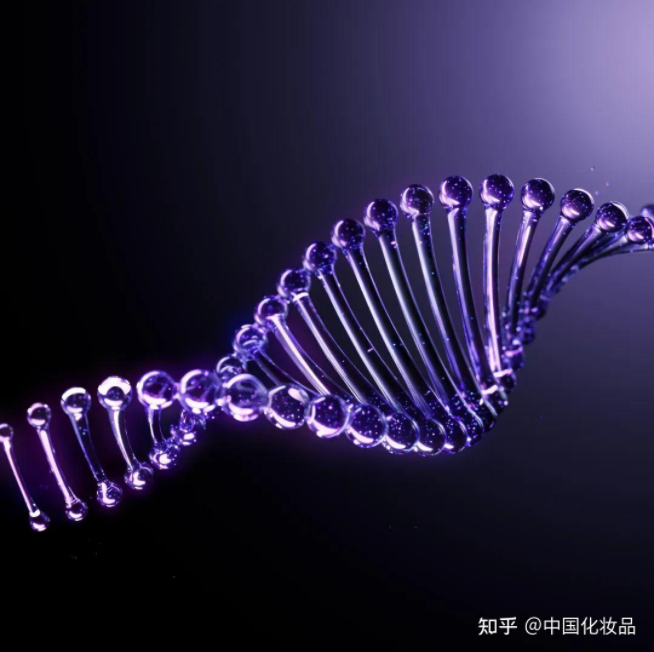
L'Oréal*** Patent PDRN Schematic Diagram
With technological iterations, the raw material sources of PDRN are no longer limited to traditional animal extraction. Plant-based sources, microbial fermentation, and synthetic biology-directed synthesis routes have successively matured, not only resolving the ethical controversies and supply chain fluctuations associated with animal-derived materials but also making raw material purity and fragment length more controllable, laying the foundation for large-scale application in skincare products.
According to industry research data from Jiuqian Zhongtai: From a mechanism-of-action perspective, PDRN is not simply about external hydration or filling. Instead, it activates adenosine A₂A receptors, regulates the PI3K/Akt and NF-κB signaling pathways, balances the expression of inflammatory and growth factors, promotes fibroblast proliferation, accelerates collagen and elastin synthesis, while inhibiting inflammatory responses and cell apoptosis, ***ultimately achieving comprehensive effects such as tissue regeneration, anti-inflammatory soothing, damage repair, and anti-aging. This mode of action, which awakens the skin's own repair capabilities at the cellular level, distinguishes PDRN from traditional skincare ingredients, making it a truly "active regenerative" substance.
The application journey of PDRN has long transcended extensive scientific research and clinical phases. In 1952, Italy's Mastelli company*** isolated PDRN from salmon reproductive cells, initially using it primarily for clinical wound healing, chronic wound repair, and burn care. Its stable restorative effects earned recognition in the medical field. Around 2010, Korean companies pioneered its introduction into the medical aesthetics arena, with brands like Lizu Lan (Lizhulan) developing PDRN into injectable products, creating the wildly popular "Salmon Shot" across Asia. Thanks to its proven effects in acne scar repair, skin texture improvement, anti-aging, and firming, it quickly established strong market awareness.
Subsequently, with breakthroughs in transdermal technology, nano-carriers, and microsphere encapsulation, PDRN finally moved beyond professional medical aesthetics settings and formally entered the mainstream skincare sector, becoming a key ingredient bridging medical technology and daily skincare.
PDRN's rapid rise as a hot choice in the skincare market is closely tied to its precise alignment with contemporary consumer needs. Against a backdrop of expanding sensitive skin populations, advancing anti-aging demands, and growing emphasis on efficacy, PDRN stands out with its gentle, efficient, multi-functional, and highly safe characteristics. It not only achieves anti-inflammatory repair but also stimulates collagen production while addressing hydration and skin barrier strengthening, improving common skin concerns like post-procedure recovery, seasonal sensitivity, acne marks, redness, aging, and laxity. Coupled with years of accumulated reputation from medical aesthetics and ingredient enthusiasts' strong endorsement of biotechnology and cell science, PDRN required minimal market education to quickly break through awareness barriers. In the first half of 2025, searches for PDRN-related keywords surged by 2213% year-over-year, with platform discussions exceeding 60 topics, solidifying its explosive market growth.
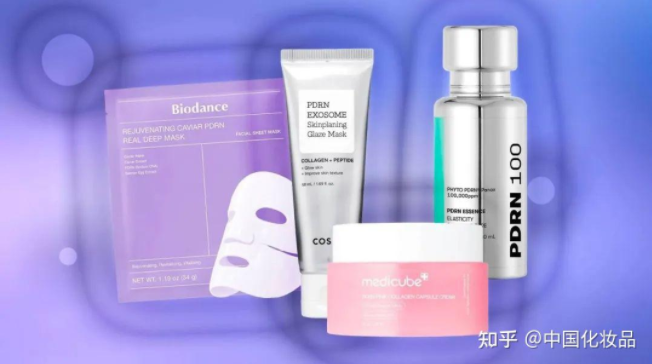
PDRN-based skincare products gaining significant attention in the European and American markets
Sales Surge: PDRN Skincare Explodes Online
300x Growth in 4 Years
According to data from Jiuqian, the sales performance of PDRN-related skincare products (i.e., cosmetics searched under the keyword "PDRN") across Tmall, JD.com, and Douyin clearly illustrates its journey from obscurity to a breakout phenomenon. The market enthusiasm for PDRN began to concentrate in 2022, prior to which the industry had little presence in this area, remaining largely unnoticed.
PDRN-based skincare products on Tmall, JD.com, and Douyin generated sales of just 1.5 million yuan (in RMB, same below) in 2022. By 2023, this figure rapidly climbed to 11 million yuan, further increasing to 32 million yuan in 2024. A full-scale breakout occurred in 2025, soaring to 408 million yuan. As of now in 2026, sales have already reached 223 million yuan, with a staggering year-on-year growth rate of 999% for the full year of 2025. Over four years, growth exceeded 270 times, demonstrating robust momentum.
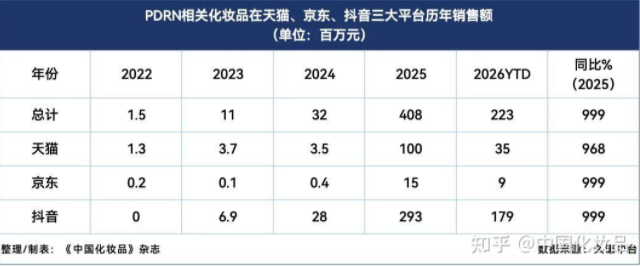
From the perspective of channel structure, the three major platforms exhibit a highly concentrated yet distinctly differentiated growth pattern, with Douyin emerging as the *** powerhouse. In 2022, PDRN product sales on Douyin were zero, but they rapidly surged to 6.9 million yuan in 2023, climbed to 28 million yuan in 2024, explosively broke through 293 million yuan in 2025, and reached 179 million yuan so far in 2026. Leveraging a comprehensive ecosystem of content seeding, live-streaming conversions, and ingredient education, Douyin has firmly established its dominance in the online PDRN market. Tmall, as the established e-commerce stronghold for brands, shows more stable growth—with sales of 1.3 million yuan in 2022, rising to 3.7 million yuan in 2023, experiencing a slight fluctuation to 3.5 million yuan in 2024, then sharply increasing to 100 million yuan in 2025, and reaching 35 million yuan so far in 2026, achieving a YoY growth rate of 968%. It serves as the core platform for mid-to-high-end product sales and brand image consolidation. JD.com, though smaller in scale, maintains rapid growth—with sales of 200,000 yuan in 2022, dipping to 100,000 yuan in 2023, rebounding to 400,000 yuan in 2024, jumping to 15 million yuan in 2025, and hitting 9 million yuan so far in 2026, boasting a 999% YoY growth rate. JD.com targets precise consumer segments by capitalizing on its reputation for authenticity and logistics advantages. Together, these three channels form a clear structure: "Douyin leading, Tmall stabilizing, and JD.com complementing."
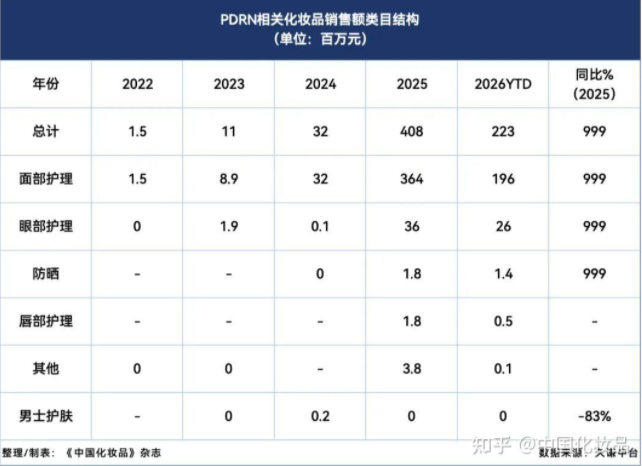
From the perspective of product category structure, PDRN has established a mature layout with facial care as the ***core and rapid expansion in segmented markets. Facial care remains the primary battlefield for PDRN applications, with sales reaching 1.5 million yuan in 2022, 8.9 million yuan in 2023, 32 million yuan in 2024, and surging to 364 million yuan in 2025. From 2026 to the present, sales stand at 196 million yuan, marking a 999% year-on-year growth. It covers mainstream forms such as serums, creams, masks, and sets, firmly dominating the market.
Eye care, as a promising sub-category, achieved a breakthrough from scratch, with sales of 1.9 million yuan in 2023, dropping to 100,000 yuan in 2024, then skyrocketing to 36 million yuan in 2025. From 2026 to the present, sales reached 26 million yuan, becoming a key direction for PDRN to expand its efficacy boundaries.
Sun protection and lip care began scaling in 2025, with sales reaching 1.8 million yuan each. From 2026 to the present, these figures stand at 1.4 million yuan and 500,000 yuan, respectively. Meanwhile, men's skincare saw a brief presence in 2024, but sales dropped to zero in 2025, an 83% year-on-year decline, indicating that the overall market remains predominantly focused on women's skincare.
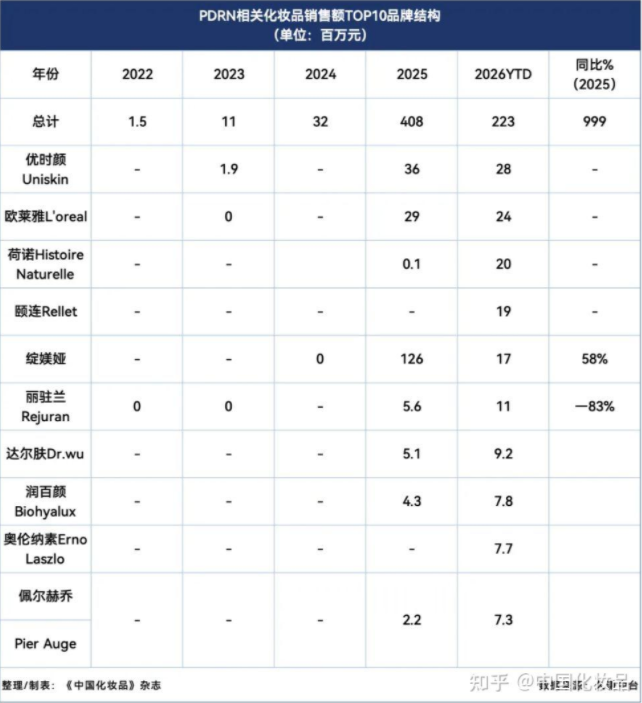
At the brand competition level, the PDRN sector exhibits a landscape where top players are highly concentrated, domestic brands lead the race, and international brands compete alongside medical aesthetic brands. Full-platform data from 2025 shows that Zimaiya topped the sector with sales of 126 million yuan, and has since accumulated an additional 17 million yuan in 2026, marking a 58% year-on-year growth, making it the most representative benchmark brand for PDRN ingredients. UNISKIN followed closely, entering the market in 2023 with 1.9 million yuan in sales, reaching 36 million yuan by 2025, and generating 28 million yuan so far in 2026, rapidly capturing market share through precise positioning. The international giant L'Oréal achieved sales of 29 million yuan in 2025 and 24 million yuan so far in 2026, securing a significant position with its brand strength and R&D capabilities. Additionally, brands like Lizhulan, Dr.Wu, and BIOHYALUX have entered the market. Among them, Lizhulan, with its medical aesthetic background, recorded sales of 5.6 million yuan in 2025 but declined to 1.1 million yuan so far in 2026, an 83% year-on-year drop. Dr.Wu and BIOHYALUX joined the mid-tier with sales of 5.1 million yuan and 4.3 million yuan, respectively. Overall, domestic brands dominate the sector with their keen awareness of ingredient trends and localized operations, while international and medical aesthetic crossover brands provide differentiated supplementation, collectively driving the PDRN sector toward standardization and maturity.
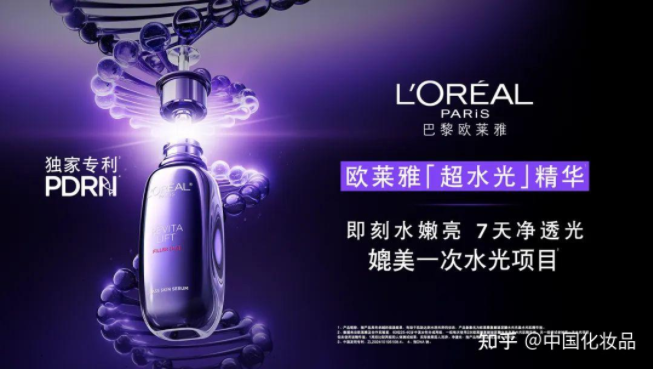
L'Oréal Paris launched the "Ultra Hydrating" serum in October 2025, featuring the patented PDRN ingredient from ***.
Hot Trend, Cool Reflection: From Boom to Maturity
Three Hurdles Remain to Overcome
Despite PDRN's heated market performance and the rush of capital and brands to capitalize on it, from a long-term industry development perspective, this ingredient is still in its early growth phase. It faces multiple practical challenges such as standardization, compliance, and technological implementation, with a necessary journey ahead before achieving a truly mature, stable, and standardized market landscape.
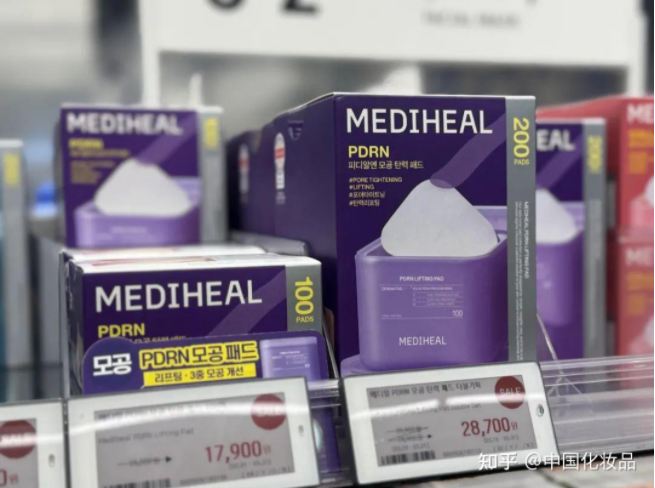
At the Olive Young store in Seoul, South Korea, a survey by the journalist from *China Cosmetics* magazine revealed that consumers pay more attention to the actual efficacy of PDRN products rather than their labels.
The most pressing issue in the current PDRN sector lies in the lack of unified industry standards. There is no consistent regulation regarding raw material sources, molecular weight, purity control, effective dosage, or efficacy evaluation methods. Significant technological disparities exist among different companies, leading to problems such as conceptual additions, inaccurate concentration labeling, and exaggerated claims. This makes it difficult for consumers to assess the true value of products based on publicly available information and poses potential risks to market trust. As more players enter the industry, the chaos caused by the absence of standards may escalate, undermining the long-term healthy development of the sector.
On the compliance front, PDRN also faces stringent regulatory requirements. In the medical aesthetics injection category, PDRN products are classified as Class III medical devices. Currently, no domestically approved products exist in the Chinese market, which remains dominated by imports. The approval process is rigorous and time-consuming, placing exceptionally high demands on local companies' R&D capabilities and clinical expertise.
For skincare applications, PDRN must comply with cosmetics regulations, requiring solid evidence for efficacy claims. Rising industry standards—such as the EU MDR certification and China’s updated cosmetics regulations—continuously raise the entry barriers. Companies must invest more in R&D, testing, regulatory filings, and clinical validation, gradually squeezing out smaller brands and opportunistic players.
Technological implementation remains a critical factor constraining the development of PDRN. While advancements such as microsphere encapsulation, nanocarriers, and microneedle transdermal delivery have significantly improved PDRN's skin penetration rates, truly stable delivery capabilities are still concentrated among a few leading brands. A large number of mid-to-low-end products lack core technical support, resulting in limited transdermal absorption efficiency and a gap between actual efficacy and marketing claims, which negatively impacts consumer experience and reputation. Additionally, the large-scale production of plant-derived and microbe-derived PDRN still requires time, with cost control and stability optimization still in progress, indicating room for improvement in the overall industry maturity.
CCR Perspective:
For PDRN, the journey from a trend to maturity necessitates continuous evolution across three critical dimensions: standardization, technology, and the market. The industry must accelerate the transition from group standards to industry and national standards, clarifying key metrics such as raw materials, formulations, efficacy, and testing. This will help eliminate low-quality and gimmicky products while fostering a healthy competitive environment. Companies need sustained investment in delivery technologies, ingredient innovation, and formulation optimization to ensure PDRN delivers stable and tangible results—shifting the focus from "ingredient hype" to "proven efficacy." Meanwhile, consumer education must deepen to transform impulsive purchases into informed choices, ensuring the true value of the ingredient is understood and recognized.
In the long run, PDRN's popularity is not merely a fleeting marketing phenomenon but an inevitable trend as regenerative medicine extends into skincare. With advancements in domestic R&D capabilities, accelerated localization of alternatives, improved regulatory frameworks, and declining technological costs, PDRN has the potential to follow in the footsteps of hyaluronic acid and collagen—emerging as another blockbuster ingredient bridging medical aesthetics and skincare, spanning clinical and consumer applications. For brands, the real opportunity lies not in chasing trends but in mastering technology, refining products, and establishing benchmarks to secure a lasting competitive edge in this technology-driven skincare revolution.