






Manganese Tripeptide-1
1、 Product basic file
Chinese name: Manganese tripeptide-1/Bioactive Peptide Manganese tripeptide-1
English name: Manganese Tripeptide-1
Nicknames: Manganese GHK, Mn GHK, Manganese Peptide
INCI Name: MANGANISE TRIPEPTIDE-1
CAS number: 611182-15-1
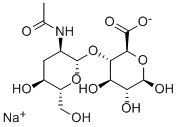
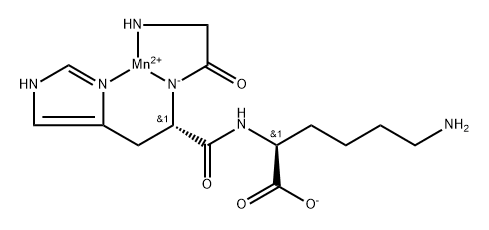
Molecular formula: C ₁₄ H ₂₂ MnN ₆ O ₄
Molecular weight: 393.3 g/mol
Amino acid sequence: Mn (II) - Gly His Lys OH (complex formed between manganese ion and glycyl-L-histidyl-L-lysine tripeptide)
Structural features: Coordination complex formed between tripeptide-1 (GHK) and manganese ion (Mn ² ⁺), where manganese ion coordinates with tripeptide through imidazole nitrogen atom and peptide bond nitrogen atom of histidine residue, forming a stable tetragonal or octahedral coordination structure
Appearance: Light pink to light brown powder (with light color characteristics endowed by manganese ions)
Purity specification: ≥ 98% (HPLC)
Solubility: Water soluble, also soluble in DMSO
Stability: Powder state can be stored for 3 years at -20 ℃, and 2 years at 4 ℃; After preparing the solution, store it at -80 ℃ for 6 months and at -20 ℃ for 1 month; Suggest avoiding repeated freeze-thaw cycles
INCI functional classification: Skin Conditioning
GHS hazard classification: unclassified (no known hazards)
Regulatory status: Used as a cosmetic ingredient and listed in the EU CosIng database
2、 Core efficacy and mechanism of action
Manganese tripeptide-1 is a metal complex of tripeptide-1 (GHK) and manganese ions, belonging to the "Carrier Peptide" family. Tripeptide-1 (Gly His Lys) is a natural endogenous peptide widely present in human blood, saliva, and urine. It has strong metal ion chelating ability and can form complexes with various transition metals such as copper, zinc, and manganese. Manganese tripeptide-1 utilizes manganese ions as a cofactor to exert unique antioxidant and photodamage repair effects through the superoxide dismutase (SOD) pathway, particularly in improving photoaging related pigmentation.
Its core efficacy and mechanism of action are mainly reflected in the following dimensions:
Antioxidant manganese SOD cofactor mechanism (core efficacy): Manganese is a key cofactor of manganese superoxide dismutase (Mn SOD, also known as SOD2). Mn SOD is the most important antioxidant enzyme in mitochondria, responsible for catalyzing the conversion of superoxide anion radicals (O ₂⁻·) into hydrogen peroxide (H ₂ O ₂), which is further broken down into water and oxygen by catalase. Manganese tripeptide-1 enhances the activity of Mn SOD by delivering manganese ions in a bioavailable form to skin cells, effectively clearing reactive oxygen species (ROS) produced in mitochondria and protecting the skin from photooxidative damage.
Improving hyperpigmentation related to photoaging (core efficacy): the clinical research published in the Journal of Cosmetic and Laser Therapy confirmed that the facial essence containing manganese tripeptide-1 was used twice a day. After 12 weeks of continuous use, the subjects showed significant improvement in hyperpigmentation, and the light damage rating was reduced from "moderate" to "mild". This is the most significant feature that distinguishes manganese tripeptid-1 from copper tripeptid-1- its more prominent performance in lightening spots and smoothing the skin.
Anti wrinkle and anti-aging: Similar to copper tripeptide-1, manganese tripeptide-1 also has anti wrinkle effects. Manganese ions participate in the cofactor functions of various enzymes, including lysyl oxidase involved in collagen cross-linking, which helps maintain the integrity and elasticity of skin structural proteins. In clinical studies, both subjects and blind reviewers observed improvements in wrinkles and fine lines.
Anti inflammation and repair: Manganese ions have natural anti-inflammatory properties, which can inhibit the release of inflammatory mediators and alleviate skin inflammatory reactions. Manganese tripeptide-1 promotes the repair process of skin damage and helps improve skin barrier function by reducing oxidative stress and inflammatory response. No significant skin inflammatory response was observed in clinical studies, indicating its good safety.
Differentiated advantages compared to copper tripeptide-1: Manganese tripeptide-1 shares the same tripeptide backbone (GHK) with copper tripeptid-1 (blue copper peptide), but the metal cofactors are different, resulting in a different emphasis on efficacy. Copper tripeptide-1 focuses on promoting collagen synthesis and wound healing (copper is a cofactor of lysyl oxidase and copper zinc SOD), while manganese tripeptide-1 focuses more on antioxidant protection and pigmentation improvement (manganese is a cofactor of Mn SOD). In addition, manganese tripeptide-1 does not exhibit a distinct blue color like copper tripeptide-1, making it more flexible in terms of formula appearance.
3、 Recommended addition ratio and application scenarios
Manganese tripeptide-1 is a water-soluble metal peptide complex, which can be added to a variety of skin care formulations such as essence liquid, face cream, lotion, facial mask, etc.
Recommended addition ratio:
Pure peptide powder: recommended addition amount of 0.01% to 0.1% (based on pure peptide), i.e. 100-1000 ppm
Commercialized solution: According to the supplier's recommendation, the general addition amount is 1% to 5% (based on the solution)
Concentration used in clinical research: the essence liquid formula used in clinical research contains manganese tripeptide-1 complex, which is used twice a day, and obtains significant effect after 12 weeks
Application Scenario:
Light damage repair essence: use its Mn SOD cofactor mechanism and significant pigmentation improvement effect to develop professional repair essence products for light aging, spots and uneven skin color caused by ultraviolet rays.
Whitening and spot lightening products: use its ability to significantly improve hyperpigmentation confirmed in clinical research, and apply it to spot lightening essence, skin smoothing lotion and other products.
Anti aging face cream/essence: use its antioxidant and anti wrinkle effects to apply to daily anti-aging care products, protect skin from free radical damage, and improve wrinkles and relaxation.
Sunscreen auxiliary products: Using their ability to enhance the skin's own antioxidant defense system as auxiliary ingredients in sunscreen products, they enhance the skin's inherent protection against ultraviolet rays.
Sensitive skin repair products: utilizing their anti-inflammatory and repair effects, applied in repair products for sensitive and damaged skin.
4、 Formula recommendations and safety compliance
Compatibility and process suggestions:
Dissolution method: Manganese tripeptide-1 has good water solubility and can be directly dissolved in aqueous systems. It is recommended to add it during the aqueous phase of the formula or after cooling
PH range: It is recommended to use within the pH range of 5.0 to 7.0 to avoid strong acid or alkali conditions that may cause metal ion dissociation
Temperature control: It is recommended to add below 40 ℃ to avoid high temperature causing peptide bond hydrolysis or metal complex dissociation
Avoid compatibility with strong chelating agents: Strong chelating agents such as EDTA may compete with manganese ions, reducing activity
Efficiency enhancing combination:
Compound with copper tripeptide-1: The two share the GHK skeleton but have different metal cofactors. Copper tripeptide-1 focuses on collagen synthesis and repair, while manganese tripeptid-1 focuses on antioxidant and plaque lightening, forming a "repair+protection" synergistic scheme
Combined with vitamin C: Vitamin C provides direct antioxidant and whitening effects, while manganese tripeptide-1 enhances endogenous antioxidant enzyme activity, forming a dual antioxidant system of "exogenous+endogenous"
Compound with Niacinamide: Niacinamide inhibits melanin transport, manganese tripeptide-1 improves photodamage and pigmentation, and the two synergistically whiten from different targets
Compound with hyaluronic acid: Hyaluronic acid provides moisturizing and filling, while manganese tripeptide-1 improves skin quality from an antioxidant and reparative perspective
Safety compliance:
Manganese tripeptide-1 is a cosmetic grade raw material, and no significant skin inflammation or adverse reactions have been observed in clinical studies. It has good tolerance
GHS hazard classification is' unclassified ', with no known hazards
Manganese is an essential trace element for the human body, and its safety is high at normal concentrations for cosmetic use
Listed in the EU CosIng database, classified as a skin conditioning agent
The powder state is stored stably, and it is recommended to store it at low temperature after preparing the solution and avoid repeated freezing and thawing
5、 Application Fields and Market Supply
Manganese tripeptide-1, as an important member of the tripeptid-1 metal complex family, has unique application value in anti-aging and photodamage repair fields.
Research and development background: Tripeptide-1 (GHK) was first isolated from human blood by Dr. Loren Pickart in 1973 and has the property of prolonging liver cell survival. Subsequently, researchers discovered that GHK can form complexes with various metal ions, with copper complexes (GHK Cu, blue copper peptide) being the most extensively studied. Manganese complexes (Mn GHK), as another important member of this family, have gradually attracted attention from the cosmetics industry due to their unique Mn SOD cofactor mechanism and outstanding performance in improving pigmentation.
Clinical evidence: Clinical studies published in the SCI journal "Journal of Cosmetic and Laser Therapy" are the most important efficacy validation of manganese tripeptide-1. This study evaluated the effect of facial essence containing manganese tripeptide-1 on facial light injury. The subjects used it twice a day for up to 12 weeks. The results showed that hyperpigmentation was the most significantly improved parameter; The light damage rating has been downgraded from "moderate" to "mild"; The treatment has good tolerability and did not induce significant skin inflammation. This study has been cited 16 times, providing solid clinical evidence to support the efficacy of manganese tripeptide-1.
Market positioning: Manganese tripeptide-1 is currently a relatively niche cosmetic active ingredient, with less market awareness and application breadth than copper tripeptide-1 (blue copper peptide). But its unique efficacy positioning - "antioxidant+spot lightening+photodamage repair" - gives it a differentiated competitive advantage in anti-aging and whitening spot lightening product formulas. With the increasing demand for "scientific skincare" and "precise efficacy" among consumers, manganese tripeptide-1 is expected to be widely used in high-end efficacy skincare products.